



Pakistan’s FY2026-27 budget is the most coherent in years. The way to lock in its gains is to broaden the tax base — and to let the FBR concentrate fully on enforcement.
It has become a habit to approach Pakistan’s budget season with low expectations. The FY2026-27 budget is a reason to revise them upward. For the first time in a long while, the document reads less like a scramble to plug a gap and more like a considered piece of policy, with a clear logic running through it.
The headline is real relief for the documented economy. The threshold for the top 35% income tax slab was raised from Rs4.1 million to Rs7 million, with new intermediate slabs smoothing the climb. The Super Tax was abolished for incomes up to Rs500 million and cut from 10% to 8% above that. The deemed-income tax on property under Section 7E was removed, the 9% surcharge on the salaried class was ended, and the withholding burden on exporters fell from 2% to 1.25%. The government also held a sensible line on rates, keeping the standard GST at 18% rather than raising it, on the reasonable grounds that a hike would feed inflation.
This is overdue and well-targeted. The salaried class alone paid more than Rs425 billion in the first three quarters of FY26, more than double the real estate sector and more than wholesalers, retailers, and exporters combined. Easing that burden was the right call, and the budget does it while staying inside a credible medium-term framework: a primary surplus of 2% of GDP, a fiscal deficit held at 3.6%, and a serious push on documentation and digitisation. After years of improvisation, this is what a thought-through budget looks like.
But ‘relief’ is a word to handle with care. The cuts are concentrated in the upper-middle and higher brackets, while the entry threshold for income tax — Rs50,000 a month — has not moved, so the lowest-paid gain nothing. Government pensions rise by just 7%, well below an inflation rate that climbed back into double digits this spring, leaving pensioners worse off in real terms. And what the budget hands back at the income-tax counter it quietly recovers elsewhere: the petroleum levy has been pushed toward Rs80 a litre, excise widened, and a clutch of consumer goods shifted to retail-price sales tax. Holding the headline GST rate at 18% was the right call — raising it would only have fed inflation — but through the levy the consumer is squeezed all the same. Table 1 sets the relief against its catch.
Table 1. What you gain — and the catch
| Measure | The change | The catch |
| Top income-tax slab (35%) threshold | Rs4.1m → Rs7m | Gains flow to higher earners; the Rs50,000/month entry threshold is unchanged |
| Super Tax | Abolished up to Rs500m; 10% → 8% above | Banking, oil-and-gas and fertiliser remain heavily taxed |
| Surcharge on the salaried class | 9% → ended | Applied only to incomes above Rs10m |
| Advance tax on exporters | 2% → 1.25% | — |
| Property & foreign-asset taxes | Section 7E deemed-income tax removed; CVT on foreign assets abolished | Higher official valuations may dilute the benefit |
| Government pay and pensions | +7% | Below an inflation rate near double digits this spring — a real-terms cut for pensioners |
| Standard GST rate | Held at 18% | But the petroleum levy is pushed toward Rs80/litre and excise widened — consumers squeezed anyway |
The question worth asking is not what is wrong with it. It is how to make sure these gains last, rather than being unwound the next time revenue comes under pressure.
The enforcement drive is working — but it cannot do this alone
Much of the credit belongs to the Federal Board of Revenue, and the numbers are genuinely impressive. FBR revenue has roughly doubled in three years, from about Rs7,200 billion in FY2022-23 to an expected Rs13,000 billion this year, and the tax-to-GDP ratio has climbed by around two percentage points to 10.3%, a pace of improvement rarely seen in Pakistan. This budget hands the FBR a powerful new toolkit to push further: e-invoicing, faceless audit and assessment, production monitoring across major sectors, and algorithmic matching of banking data against tax declarations. Enforcement and documentation are where a tax administration earns its keep, and the FBR is visibly getting better at both. It should be left to pursue this with full focus.
But here is the arithmetic that defines the problem. For FY27, tax revenue must rise 17.6% in a single year, from Rs12,983 billion to Rs15,264 billion. The target was widely described in the budget coverage as over-ambitious, and the arithmetic explains why.
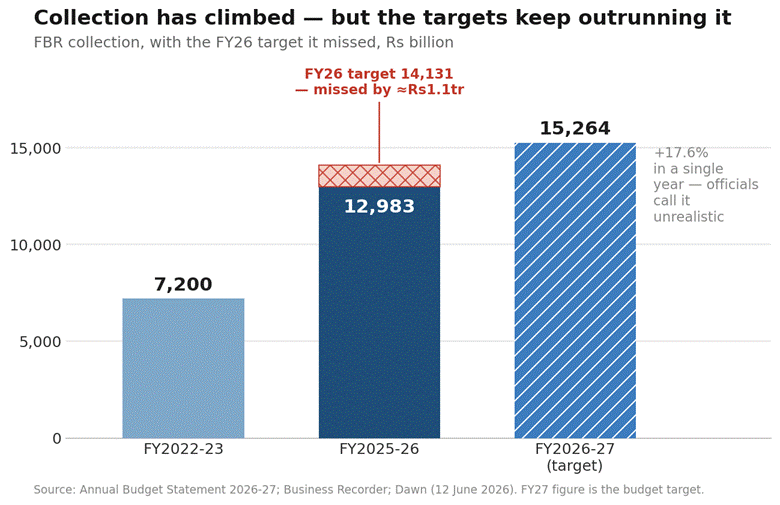
Figure 1. FBR collection against the FY26 target it missed, Rs billion. The FY27 figure is the budget target.
Of that increase, the budget’s new permanent tax measures account for only about 0.3% of GDP, roughly Rs430 billion shared between the centre and provinces; the rest is expected to come from autonomous growth and enforcement. In other words, the budget is asking enforcement and economic growth to carry almost the entire revenue burden, while the structure of the base barely moves.
That is a rational way to hit one year’s number. It is not a durable way to fund relief, for one simple reason: much enforcement yield does not repeat. When the FBR collected Rs327.7 billion in court-confirmed Super Tax arrears as a prior action this year, the IMF itself recorded it as a one-off windfall, not a structural gain. You cannot collect the same arrears twice. A revenue plan that leans on enforcement is leaning, in part, on a source that has to be regenerated from scratch each year. The permanent prize lies elsewhere.
The opportunity ahead: a wider base
To see why the base, and not enforcement, is the real prize, look at what the federal government is left with. The FBR is set to collect Rs15,264 billion, but Rs8,848 billion of that flows to the provinces under the NFC award. That leaves the centre roughly Rs6,416 billion from the country’s main tax machine. Against this, debt servicing alone consumes around Rs8,054 billion. The interest bill is about a quarter larger than the federal government’s entire retained share of FBR taxes. Before a single rupee is spent on defence, development, or relief, what the centre keeps from the tax system does not even cover what it owes in interest.
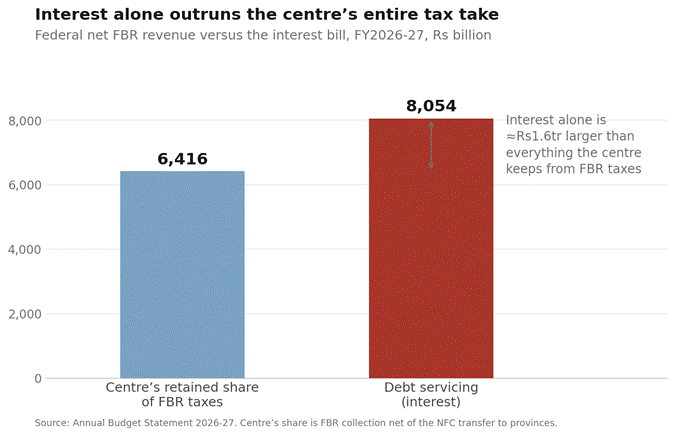
Figure 2. Federal net FBR revenue versus the interest bill, FY2026-27 (Rs billion).
That is the trap, and it is why base broadening is no longer optional. It cannot be filled by squeezing the documented harder; they are already carrying it. It can only be filled by bringing the untaxed into the net. And here the scale of the missed opportunity is striking.
The clearest description comes from the IMF, which is worth dwelling on because it reframes the Fund from antagonist to ally. In its most recent review, the Fund reported that Pakistan’s GST C-efficiency ratio, the share of the theoretical consumption base actually captured by the tax, has fallen from 27.4% to 22.8% over the past decade. At an 18% rate, only about a quarter of the potential base is taxed. Raising C-efficiency to 35%, still below regional peers like Indonesia, Turkey, or Morocco, would generate roughly Rs2.1 trillion, about 1.8% of GDP. Set that beside the budget’s actual new measures of 0.3% of GDP: the GST prize alone is worth around six times the entire fresh revenue effort this budget makes, and roughly a third of the federal government’s whole retained tax take. It would fund the relief in this budget many times over, permanently.
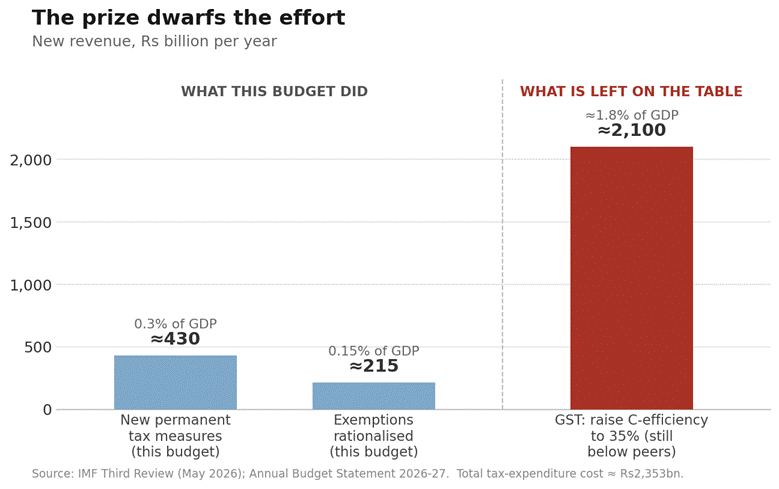
Figure 3. The budget’s new revenue measures set against the GST base-broadening prize left untapped (Rs billion).
The same review names agriculture, 24.6% of value added taxed at an effective rate of 0.3%, as the single largest undertaxed sector. It is not alone. Wholesale and retail trade, a vast share of activity, contributes a fraction of what its size implies, which is precisely why the documented salaried class, paying over Rs425 billion in three quarters, more than double the entire real estate sector, ends up carrying so much. Agriculture and retail are the two great gaps in the net. And the budget’s own Tax Expenditure Report puts the cost of exemptions and concessions at Rs2,353 billion, of which this budget rationalises around 0.15% of GDP, roughly Rs215 billion. Put plainly, over Rs2.1 trillion of exemptions are left standing. The base is barely touched. Table 2 maps where it leaks.
Table 2. The gaps in the net
| Where the base leaks | The gap today | What it could yield |
| GST collection efficiency | 22.8% of the potential base captured — down from 27.4% a decade ago | Lifting it to 35% (still below Indonesia, Turkey, Morocco) ≈ Rs2.1tr, about 1.8% of GDP |
| Agriculture | ≈24.6% of value added, taxed at an effective 0.3% | The single largest undertaxed sector — and where the landowners are |
| Wholesale & retail trade | A vast share of activity, a fraction of the tax | Why the documented salaried class ends up carrying so much |
| Exemptions & concessions | Rs2,353bn total cost; only ≈Rs215bn trimmed this year | Over Rs2.1tr left standing |
| Customs | Trade-weighted tariff cut from 10.7% to 8.9%, by design | A revenue pillar eroding — making domestic base-broadening “non-optional” |
The point the institutional language tends to soften is a blunt one. These are not obscure technical gaps; they are the politically protected sectors. Agriculture is where the landowners are; retail is where the traders are; real estate, which this budget hands fresh relief, is where a great deal of untaxed money is parked. The narrow base is not an accident of administration. It is a choice, remade every year, to tax the people who cannot escape and spare the people who can.
Two further pressures make widening it urgent rather than merely desirable. Customs revenue, historically a quarter of FBR collection, is being deliberately shrunk: the National Tariff Policy has cut the trade-weighted average tariff from 10.7% to 8.9% and will cut further, so a traditional revenue pillar is eroding by design. The IMF’s conclusion is blunt: domestic base-broadening is now, in its word, non-optional. A narrowing customs base and a narrow domestic base cannot both hold.
Here too the budget makes a genuine start. It introduces a simplified fixed scheme for small traders, learning from earlier attempts that fell short, and raises the agricultural income tax applied to farm income, building on the provincial reforms now legislated across the country. These are the right opening moves. But bringing agriculture and retail in durably is a long, sector-by-sector campaign, not a single budget, and that is exactly the kind of patient design work that needs dedicated attention.
So the public framing of the IMF has it backwards. The Fund’s hard revenue target is one thing; its analysis is another. On the analysis, the IMF is the most candid advocate for the base-broadening agenda that would make this budget’s relief permanent. That is an opportunity, not a constraint.
Two different jobs
This points to why base design needs a home of its own. Collecting revenue and widening the base reward different things. Enforcement is measured quarterly, in a single collection figure that from December 2026 becomes a hard Quantitative Performance Criterion under the IMF programme, where a miss can halt disbursement. Redesigning the base is slow, analytical, and politically delicate, and pays off over years.
Economics calls this tension the multitasking problem, set out by Holmström and Milgrom (1991): when one body is judged on only one of its several jobs, effort flows, rationally, to the task that is measured. This is not a failing; it is what any well-run organisation does. An administration judged on this quarter’s collection will, quite properly, put its energy into collection.
This is the insight that explains the budget’s financing. The relief was paid for by enforcement and autonomous growth rather than a wider base not because anyone chose enforcement over reform on the merits, but because the institution drawing up the revenue plan is scored, quarter by quarter, on a collection number, and the base-broadening that would have paid for the relief more durably sits on a horizon no quarterly target can see. Point the incentive at collection and you get collection. That is a reason to fix the incentive, not to fault the body responding to it. The fix is specialisation: let the FBR concentrate on enforcement and collection, where it is delivering, and give base design dedicated capacity with the time and remit to think in years.
Building on what the budget started
Encouragingly, the government has already taken the first step. Tucked into the budget’s own Statement of Fiscal Risks is a quietly significant line: the government has “established a dedicated tax policy function while strengthening tax administration, risk-based enforcement, and digital integration.” A dedicated tax policy capability now exists, and the IMF has made a medium-term tax reform strategy, to be produced through it, a structural benchmark for end-December 2026. The task is to build it out: to give it real analytical depth and the standing to design a broader, fairer base, while the FBR gets on with the enforcement job it is already doing well. The two are complements. Stronger administration raises the yield from the existing base; a wider base gives that administration far more to collect.
This is the path Pakistan’s competitors have taken. South Africa pairs a capable, enforcement-focused revenue service with dedicated tax-policy capacity in its National Treasury, and the combination is why it became the continent’s benchmark. Indonesia, the very peer the IMF holds up on C-efficiency, runs tax policy through a dedicated fiscal-policy body within its finance ministry. The countries Pakistan measures itself against pair strong collection with strong, separate policy design. Pakistan has just begun to do the same and can build on it deliberately and on its own terms.
The hard part is done
The FY2026-27 budget did the genuinely difficult thing. It delivered real relief, rationalised an over-burdened rate structure, pushed documentation forward, and held it within a coherent medium-term plan. The FBR’s enforcement drive is central to that achievement and deserves room to run.
But the arithmetic is unforgiving: with the centre’s retained tax take falling short of its interest bill, and a customs base shrinking by design, the relief in this budget can only be made permanent by widening the base — work the reform strategy is rightly required to do in a revenue-neutral way, broadening to fund relief rather than cutting first and hoping. That is a different job from collection, and it needs dedicated capacity working in parallel with a focused FBR. The government has made a start. Building it out is how Pakistan turns a good budget into a lasting one, so that next year’s document can deepen this year’s gains rather than defend them.
References
Government of Pakistan, Finance Division, Annual Budget Statement 2026-27, including the Statement of Fiscal Risks, the Statement of Estimated Tax Expenditure, and the summary of receipts and expenditure.
Government of Pakistan, Federal Board of Revenue, Salient Features: Budget 2026-27 (Income Tax Ordinance 2001, Sales Tax Act 1990, Federal Excise Act 2005, Customs Act 1969).
International Monetary Fund, Pakistan: Third Review Under the Extended Arrangement Under the Extended Fund Facility and Second Review Under the Resilience and Sustainability Facility Arrangement, IMF Country Report No. 26/101, May 2026. Earlier figures draw on IMF Country Report No. 25/332, December 2025.
Syed Irfan Raza and News Desk, “Govt unveils Rs18.8tr budget for FY2026-27; GDP growth targeted at 4pc,” Dawn, 12 June 2026.
Bengt Holmström and Paul Milgrom, “Multitask Principal–Agent Analyses: Incentive Contracts, Asset Ownership, and Job Design,” Journal of Law, Economics, & Organization 7 (1991): 24–52.