

As America rediscovers tariffs and the world re-industrialises, Pakistan sits at a crossroads, with the factories it never built, the steel policy it never wrote, and a semiconductor window that is closing fast.
1. The Global Moment: Industry Is Back on the Agenda
There is a quiet irony in watching the United States, the country that wrote the rulebook on free trade for eight decades, slap tariffs on steel, semiconductors, solar panels, and electric vehicles from China. The Trump administration’s sweeping tariff agenda, including a 145% levy on many Chinese goods, has upended the post-war consensus that open markets are always and everywhere superior. Whether or not one agrees with Washington’s approach, the signal it sends to the developing world is unmistakable: industrial capacity matters. Countries that make things are countries that have leverage.
This is not merely an American instinct. The US CHIPS Act (2022) committed $52 billion to rebuild domestic semiconductor manufacturing. The European Chips Act followed. South Korea, Japan, and Taiwan have maintained industrial policy frameworks continuously. Even the International Monetary Fund, historically skeptical of industrial intervention, published a 2024 working paper concluding that export-oriented industrial policy targeting sophisticated industries was the “secret ingredient” of the Asian economic miracles
(Cherif and Hasanov 1)
Industry is not merely one sector among many. It is the sector that drives all others. Manufacturing creates direct employment at scale, generates the foreign exchange that finances imports across the entire economy, anchors supply chains that pull in services, logistics, and agriculture, and produces the technological spillovers, learning-by-doing, knowledge transfer, productivity gains, that lift wages economy-wide. A country without a strong industrial base is a country permanently dependent on commodity exports and remittances to fund the imports its citizens need. That is precisely Pakistan’s trap.
Pakistan, by contrast, has spent the better part of four decades doing the opposite of building that leverage. Its manufacturing sector has stagnated, its export basket has barely changed since the 1990s, and its factories produce a narrower range of goods today than comparable economies did a generation ago. The country’s real exports per capita, adjusted for inflation, have remained nearly flat for four decades, a damning statistic buried in the government’s own National Industrial Policy 2025-2030. (Ministry of Industries and Production 4)
2. The Crisis in Plain Numbers
Manufacturing and mining together constitute just 13.5% of Pakistan’s GDP, yet contribute a staggering 58% of the overall corporate tax burden, according to the Pakistan Business Council. (Ministry of Industries and Production 6)
Industry is being taxed at rates that crush its competitiveness while sectors like real estate, wholesale, and retail enjoy a substantially lighter burden. The result is predictable: capital flows away from factories and into property speculation. Industrial land inside Special Economic Zones has often been “colonized” for real-estate development.
Credit is equally choked. Approximately 80% of formal-sector lending is absorbed by government borrowing, leaving a meagre 11.4% of GDP in credit available for all private sector activity. Less than 10% of registered exporters had access to formal financing as recently as 2023. (World Bank, October 2025, 1
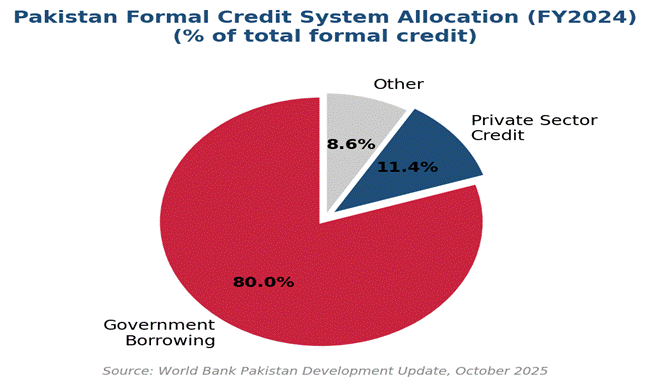
Figure 1: Pakistan Formal Credit System Allocation, FY2024: Government vs. Private Sector Source: World Bank Pakistan Development Update, October 2025 [1].
Then there is power. Industrial electricity costs in Pakistan are nearly double the regional average once taxes are included, and firms report an average of 22 power outages per month versus a lower-middle income country average of 6.5. Running a factory competitively on these terms is not difficult; it is close to impossible. (Ministry of Industries and Production 6)
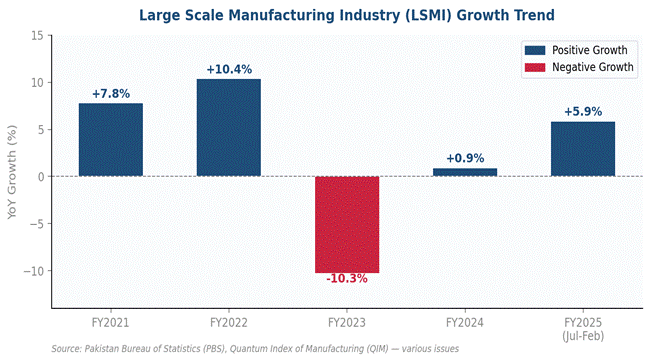
Figure 2: Large Scale Manufacturing Industry (LSMI) Growth Rate, FY2021–FY2025-26 (July-February) Source: Pakistan Bureau of Statistics, Quantum Index of Manufacturing, various monthly issues [2].
The Large Scale Manufacturing Index tells the story starkly. After a post-pandemic bounce of 10.4% in FY2022, industrial output collapsed by 10.3% in FY2023, a contraction not seen since the 1970s. The modest 0.92% recovery in FY2024 and the 5.89% growth in the first eight months of FY2025 are welcome, but they mask an industrial base that has been chronically underperforming its potential for a generation. (PBS [2])
3. What the World Is Learning and What Pakistan Keeps Forgetting
A recent World Bank study, Industrial Policy for Development, identifies fifteen policy tools and ranks them by effectiveness. The inconvenient truth for Pakistan is that the best tools, production subsidies, innovation grants, large-scale skills development, and consumption subsidies, require fiscal space and government bandwidth that Pakistan does not currently possess under its IMF Extended Fund Facility. But other tools could be powerful enough if used intelligently. Per the World Bank’s framework, Pakistan’s constraint profile, small government bandwidth, large local market, and small fiscal space, means the viable toolkit consists of:
- ✔ Import tariffs (the primary available instrument (Tool 9 in the World Bank taxonomy, 2nd choice ranking)
- ✔ Industrial parks and Special Economic Zones (Tool 1 in WB report, 1st choice ranking)
- ✔ Local content requirements (Tool 12 categorized as 2nd choice in the report)
- ✔ Technology transfer quid pro quo, especially through CPEC (Tool 11, WB report’s 2nd choice)
- ✔ Commodity export bans, selectively where Pakistan has market share (Tool 7 in the report but was classified as 2nd choice)
- ✔ Competitive exchange rate management (Tool 14 in the report classified as 2nd choice under macroeconomic category)
- ✔ R&D tax credits, to be phased in post-stabilisation (Tool 15 in the report categorized as 2nd choice)
Source: Fernandes and Reed, “Industrial Policy for Development,” CFA Society Pakistan Presentation, Slide 14, 9 April 2026. Pakistan is explicitly identified as a Small-bandwidth, Large-market, Small-fiscal-space country in the World Bank’s country typology [22, 23].
The most important available tool, and the one most frequently misused, is the import tariff. Pakistan already has an average tariff of 9.7%, above its lower-middle income peer average, but deploys tariffs indiscriminately: protecting entrenched incumbents indefinitely while failing to build any new industrial capacity. (Fernandes and Reed 9)
The lesson from South Korea, Japan, and Vietnam is not that tariffs work automatically — it is that performance-linked, time-bound tariffs with credible enforcement of sunrise and sunset clauses produce industrial development. Indefinite protection without accountability produces rent-seeking.
4. The South Africa Warning: What Happens When You Liberalise Too Fast
There is an equally important lesson from what happens when a country liberalises tariffs too fast, without building a performance-driven framework to replace them. South Africa is the textbook case, cited by economist Dani Rodrik as the clearest modern instance of premature deindustrialization. (Rodrik 1)
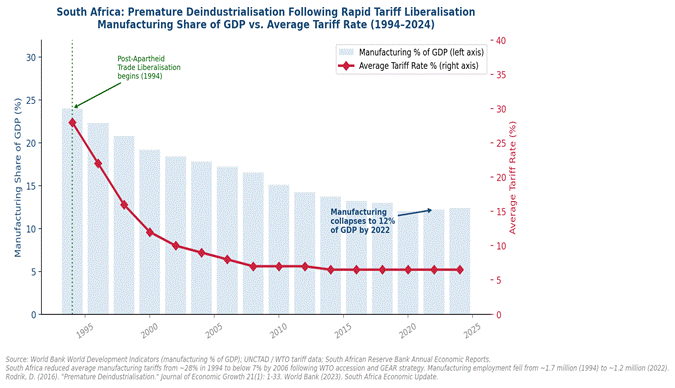
Figure 3: South Africa’s Premature Deindustrialisation Following Rapid Tariff Liberalisation, 1994–2024 Manufacturing Share of GDP vs. Average Tariff Rate. Source: World Bank World Development Indicators [17]; UNCTAD/WTO tariff data; South African Reserve Bank Annual Reports [25]. Rodrik (2016) [28].
Following the end of apartheid in 1994, South Africa slashed average manufacturing tariffs from 28% to below 7% within a decade. Manufacturing’s share of GDP collapsed from 24% to 12%; a twelve-percentage-point destruction of industrial capacity over three decades, while manufacturing employment fell from 1.7 million to 1.2 million workers. (Rodrik 1–33; World Bank, South Africa, 2023)
Pakistan’s National Industrial Policy 2025-2030 proposes reducing the average tariff to below 5% by 2030. This is the right long-run direction for input tariffs. But applied uniformly and without a sector-specific protection schedule for nascent industries, it risks recreating South Africa’s experience. Liberalisation must be dual-track: immediate for inputs, performance-linked for final goods in developing sectors (Ministry of Industries and Production 10).
5. What Pakistan Can Build in Twenty Years
The case for industrial policy is not only defensive. The scenario below models what well-designed, performance-linked tariff and localisation policy could deliver for Pakistan’s manufacturing sector through 2045.
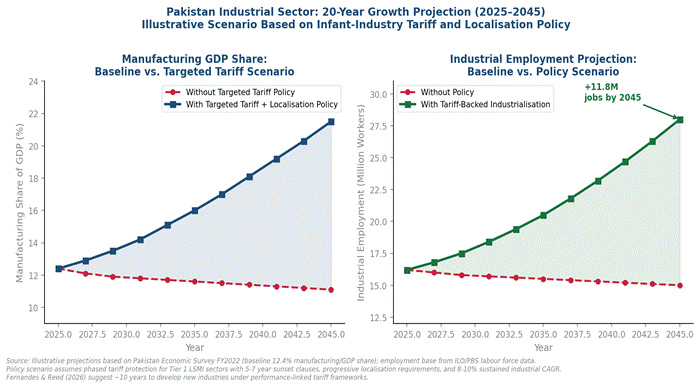
Figure 4: Pakistan Industrial Sector: 20-Year Growth Projection (2025–2045) Baseline vs. Targeted Tariff and Localisation Policy Scenario. Source: Illustrative scenario based on PBS Economic Survey FY2022 baseline [8]; ILO/PBS Labour Force Survey 2023-24 [29]. Modelled on Fernandes and Reed (2026) [22] and East Asian industrial development trajectories. Note: This is an illustrative scenario, not an official forecast.
Under the policy scenario: 5 to 7 year performance-linked tariff protection for priority sectors, progressive localisation requirements, sustained 8 to 10 percent industrial compound annual growth rate, and anchor investor attraction, manufacturing’s share of GDP rises from 12.4% today to an estimated 21.5% by 2045, generating approximately 11.8 million additional industrial jobs. (Fernandes and Reed 28; PBS [8]; ILO [29])
These are not just factory jobs. Each industrial worker creates downstream demand in services, retail, transport, and construction. Economists typically estimate a manufacturing jobs multiplier of between 1.5 and 2.5 indirect jobs per direct manufacturing position. The case for industrial development is therefore a case for broad-based employment growth across the Pakistani economy.
6. Pakistan’s Export Base: Concentrated and Vulnerable
The structural weakness of Pakistan’s export base becomes visible when its composition is examined. Textiles and apparel account for over 54% of all merchandise exports, yet remain concentrated in low-value commodity products such as raw cotton, basic yarn, undifferentiated fabric rather than the man-made fibres, technical textiles, and branded apparel that command premium margins in global markets
(PBS [3]; The Textile Think Tank [12])
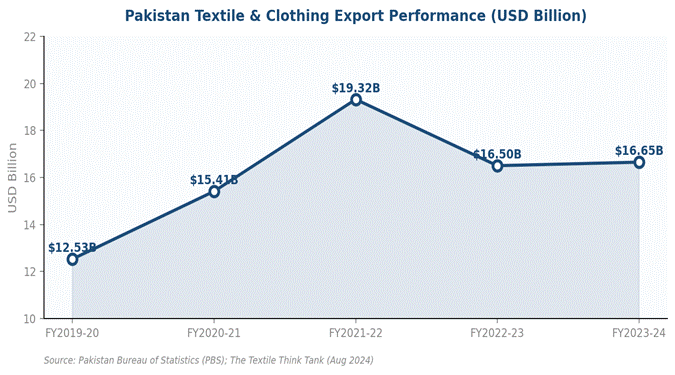
Figure 5: Pakistan Textile and Clothing Export Performance, FY2019-20 to FY2023-24 (USD Billion) Source: Pakistan Bureau of Statistics [3]; The Textile Think Tank, August 2024 [12].
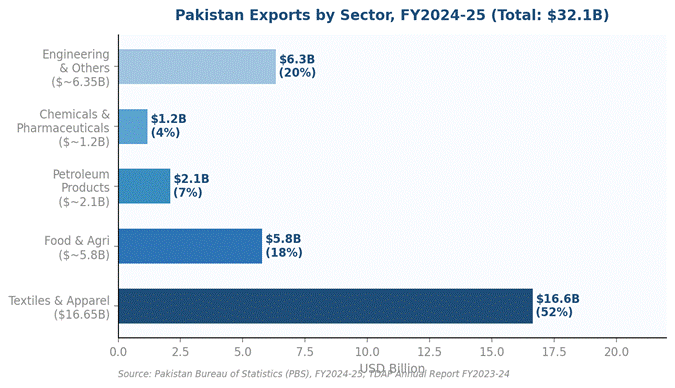
Figure 6: Pakistan Exports by Sector, FY2024-25 (Total: $32.1 Billion) Source: Pakistan Bureau of Statistics, FY2024-25 [3]; TDAP Annual Report FY2023-24 [4].
This concentration is itself an industrial policy failure. Vietnam has transformed its export base from agricultural commodities to electronics, machinery, and clothing over two decades. Bangladesh built an entire garment manufacturing industry from near-zero in the 1980s. Pakistan’s export trajectory, essentially flat in real per capita terms over four decades, reflects not a lack of potential but a lack of deliberate policy to develop new export capabilities.
7. The Sectors That Need Their Own Policies
One of the most important structural weaknesses of Pakistan’s current approach is the reliance on a single horizontal National Industrial Policy for a manufacturing sector of extraordinary diversity. Steel, semiconductors, textiles, pharmaceuticals, and automobiles have fundamentally different technology profiles, energy requirements, and supply-chain dynamics. They cannot be governed by a single document.
It is genuinely encouraging that sector-specific policies are emerging for automobiles, gems, lithium-ion batteries, and Battery Energy Storage Systems (BESS). These sectors feature activities that are new to the economy, create knowledge spillovers, and have learning-by-doing potential, that serious industrial policy should target (Fernandes and Reed 22)
7.1 A Dedicated Steel Policy
Pakistan’s steel sector is a critical backbone industry that underpins construction, engineering goods, infrastructure, and defence manufacturing. Yet it has no dedicated sector policy. Pakistan imports steel at volumes that a domestic industry, with the right energy pricing, scrap collection infrastructure, and Direct Reduced Iron technology incentives, could largely substitute. (World Steel Association [27])
- Develop domestic scrap collection infrastructure and negotiate long-term iron ore supply agreements.
- Provide dedicated industrial energy pricing for steel plants, including captive power provisions, to achieve regional cost parity.
- Incentivize transition from scrap-based Electric Arc Furnace production to higher-grade Direct Reduced Iron technology.
- Use government PSDP infrastructure procurement to create guaranteed domestic demand for Pakistani steel during the industry’s capacity-building phase.
- Implement credible anti-dumping investigation mechanisms for steel imports from China, Turkey, and Ukraine.
7.2 A Forward-Looking Semiconductor and Electronics Policy
Perhaps the most ambitious but strategically important recommendation is that Pakistan develop a dedicated Semiconductor and Advanced Electronics Policy. The global semiconductor market reached $627 billion in 2024 and is projected to exceed $1 trillion by 2030 (SEMI [28])
Pakistan does not need to manufacture leading-edge chips, a capital requirement dominated by TSMC, Samsung, and Intel. The realistic entry points are semiconductor packaging and testing, printed circuit board assembly, electronic components assembly, and chip design and Electronic Design Automation services leveraging Pakistan’s estimated 300,000-plus IT professionals.
- Establish at minimum one dedicated electronics manufacturing zone with guaranteed power supply and regulatory simplification.
- Target anchor investors from China, South Korea, and Taiwan for semiconductor packaging with competitive incentive packages.
- Develop semiconductor design curricula at NUST, COMSATS, and FAST to build a local EDA talent pipeline.
- Commit to a phased 15 to 20 year development horizon with clear milestones at 5-year intervals.
- Leverage CPEC’s SEZ framework to attract Chinese semiconductor firms relocating under US export control pressures.
A semiconductor policy for Pakistan is not a fantasy, it is a necessity. The countries that position themselves in electronics packaging and design services in the next decade will capture the industrial jobs of the 2030s and 2040s. Pakistan’s window to enter this sector will not stay open indefinitely (Fernandes and Reed 22; SEMI [28]).
7.3 Lithium-Ion Batteries, BESS, and Gems
Pakistan’s lithium and cobalt mineral endowments in Balochistan give the country a genuine comparative advantage in battery value chains that no other South Asian economy possesses. The emergence of dedicated policies for lithium-ion batteries and Battery Energy Storage Systems is strongly welcomed. The policy must develop an integrated mining-to-manufacturing framework, from raw mineral extraction and beneficiation through cathode material production, cell assembly, and pack integration, rather than exporting raw lithium.
Similarly, Pakistan is one of the world’s most significant sources of precious and semi-precious stones: rubies from Hunza, emeralds from Swat, and diverse minerals from Gilgit-Baltistan and Balochistan. A dedicated gems policy should restrict raw stone exports in favour of value-added cut and polished exports, following India’s Surat diamond cutting industry model, and develop international certification standards to command premium pricing in European and GCC markets.
8. Review of the National Industrial Policy 2025-2030
The National Industrial Policy 2025-2030, made available as a Draft for Discussion in August 2025, tackles the relevant issues.
What the NIP Gets Right
- Correct diagnosis of cascading tariffs, disproportionate tax burden on manufacturing, and excessive regulation as the core constraints on industrial investment.
- Fiscal realism: production subsidies and innovation grants explicitly excluded as unavailable under the IMF programme.
- Emergence of sector-specific policies for automobiles, gems, lithium-ion batteries, and BESS: a progressive and welcome shift.
- Emphasis on market-determined exchange rate and FX retention flexibility for exporters.
- EXIM Bank expansion, invoice-backed financing, and back-to-back letters of credit as credit access tools.
- Energy sector reforms including wheeling policy and special tariffs for EVs, data centres, and battery storage.
Where the NIP Must Go Further
- The broad tariff liberalisation to below 5% by 2030 risks premature deindustrialisation without a sector-specific protection schedule for nascent Tier 1 industries. A dual-track approach: immediate liberalisation of input tariffs, performance-linked protection of final goods for developing sectors, is essential.
- Steel, semiconductors, engineering goods, chemicals, and petrochemicals have no dedicated sector policies. Each major LSMI constituent requires its own policy document.
- The NIP does not enumerate the zero-cost second-choice tools available within IMF constraints: local content requirements, public procurement preference, and technology transfer quid pro quo. These should be explicitly adopted.
- Capital markets democratization, requiring firms receiving incentives to maintain meaningful Pakistan Stock Exchange public floats, is absent. This is both an accountability mechanism and an equity instrument.
- No LSMI-linked monitoring dashboard with publicly reported sector-wise KPIs and automatic benefit withdrawal for non-compliant firms.
Companies receiving significant state support such as tariff protection, concessional credit, or tax benefits should be required to maintain a meaningful public float on the Pakistan Stock Exchange. This is not merely a financial regulation. It is an industrial policy accountability tool. When protection benefits are democratized through capital markets, the public has a stake in industrial success, and firms face market-based scrutiny of their performance (Internal Working Papers [21]).
9. Conclusion: The Window Is Open — But Not Forever
Pakistan’s young population is either its greatest industrial asset or its most acute crisis, depending entirely on whether the factories exist to employ young workers. Industrial policy is not an abstraction. It is the answer to the question of whether the next generation of Pakistanis works in manufacturing and services of rising value, or in the informal economy of stagnant wages. The countries that built their industrial base in the 2000s and 2010s: Vietnam, Bangladesh, and Ethiopia are now competing for the next wave of manufacturing investment. Pakistan is still debating the foundations. The semiconductor opportunity, the battery supply chain realignment, the reshoring of light manufacturing from China; these are available today. They will be captured by countries that act with clarity and speed.
Seven priorities should anchor Pakistan’s industrial transformation over the next decade:
- Sector-specific policies for every major LSMI constituent: steel and semiconductors most urgently.
- Dual-track tariff strategy: liberalise input tariffs immediately; maintain performance-linked protection on final goods for Tier 1 developing sectors with explicit 5–7 year sunset clauses.
- Quality as the value-chain ladder: reward firms that invest in international quality certification, ESG compliance, and product upgrading: the mechanisms for moving from low-margin OEM to high-margin ODM and OBM manufacturing.
- Capital markets accountability: mandatory meaningful PSX listing for all firms receiving sustained state support.
- Federal-provincial co-investment: provincial development budgets and provincial banks as partners in industrial financing, not spectators.
- LSMI-linked monitoring dashboard with quarterly public reporting and automatic benefit withdrawal for non-compliant firms.
- Anchor investor strategy for batteries, electronics, and engineering goods, attracting the globally integrated manufacturing players that generate supply-chain depth and technology spillovers.
The goal is not to protect Pakistani industry from the world. It is to prepare Pakistani industry to compete in the world; and win. That requires not more protection, but smarter policy: disciplined, conditional, quality-focused, sector-specific, and accountable.
Works Cited
All citations follow MLA 9th Edition format. In-text citations appear in parentheses throughout the article. Bracketed numbers [N] in figure captions correspond to entries in this list.
[1] World Bank Group. Pakistan Development Update — October 2025. World Bank, 2025, www.worldbank.org/en/country/pakistan/publication/pakistan-development-update.
[2] Pakistan Bureau of Statistics. “Quantum Index of Large Scale Manufacturing Industries (QIM) — Monthly Issues FY2021–FY2026.” PBS Industry Section, www.pbs.gov.pk/industry-2/. Accessed May 2026.
[3] Pakistan Bureau of Statistics. Annual Analytical Report on External Trade Statistics of Pakistan, FY2023-24. Government of Pakistan, 2024, www.pbs.gov.pk.
[4] Trade Development Authority of Pakistan. Pakistan Trade Perspective — Annual Report FY2023-24. Ministry of Commerce, Government of Pakistan, 2024, tdap.gov.pk.
[5] State Bank of Pakistan. “Export Finance Scheme and Long-Term Financing Facility Policy Documentation.” SBP Monetary Policy, various years, www.sbp.org.pk.
[6] Government of Pakistan. Export-Import Bank of Pakistan Act, 2022. Ministry of Finance, 2022.
[7] Government of Pakistan. “Chapter 3: Manufacturing and Mining.” Pakistan Economic Survey FY2021-22. Ministry of Finance, 2022, www.finance.gov.pk.
[8] Securities and Exchange Commission of Pakistan. “Secured Transactions Registry — Policy Framework.” SECP, www.secp.gov.pk. Accessed May 2026.
[9] International Monetary Fund. Pakistan: Staff Reports under Stand-By Arrangement and Extended Fund Facility (2022–2025). IMF, 2022–2025, www.imf.org/en/countries/PAK.
[10] Small and Medium Enterprise Development Authority. Estimating Manufacturing SMEs Contribution to Pakistan’s GDP. SMEDA Research Report, June 2022, smeda.org.
[11] The Textile Think Tank. “Trends in Pakistan Textile & Clothing Exports.” The Textile Think Tank, 7 Aug. 2024, thetextilethinktank.org/trends-in-pakistan-textile-clothing-exports/.
[12] International Growth Centre. “Barriers to Growth: The Case of Small Firms in Pakistan.” IGC, www.theigc.org/collections/barriers-growth-case-small-firms-pakistan. Accessed May 2026.
[13] Xinhua. “Pakistan’s Exports Rise 4.7% in FY2024-25.” Xinhua News Agency, 3 July 2025, english.news.cn.
[14] World Bank Group. “Domestic Credit to Private Sector (% of GDP) — Pakistan.” World Development Indicators, data.worldbank.org/indicator/FS.AST.PRVT.GD.ZS. Accessed May 2026.
[15] Government of Pakistan. National Industrial Policy — Framework Documents, Various Years. Ministry of Industries and Production.
[16] Board of Investment Pakistan. Special Economic Zones Act, 2012 and Amendments. Government of Pakistan.
[17] Ministry of Industries and Production. National Industrial Policy 2025-2030: Draft for Discussion. Government of Pakistan, Aug. 2025.
[18] Internal Working Papers. Aligning National Industrial Policy with LSMI (2025); Credit Availability and Access to Financing for Industries (2025); Localisation Section (2025); Pakistan Export-Led Reform Strategy V6 (Oct. 2025). Government of Pakistan / Policy Research Unit.
[19] Fernandes, Ana Margarida, and Tristan Reed. Industrial Policy for Development: Approaches in the 21st Century. World Bank Group Policy Research Report, 2026, www.worldbank.org/en/publication/industrial-policy-for-development.
[20] Fernandes, Ana Margarida, and Tristan Reed. “Industrial Policy for Development.” Presentation Slides, CFA Society Pakistan, 9 Apr. 2026. World Bank Group. Slide 12: “Fifteen industrial policy tools are available, but not all equal.” Slide 14: “In Pakistan, small bandwidth and fiscal space mean some first-choice tools are not available.”
[21] Rodrik, Dani. “Premature Deindustrialisation.” Journal of Economic Growth, vol. 21, no. 1, 2016, pp. 1–33, doi:10.1007/s10887-015-9122-3.
[22] World Bank Group. South Africa Economic Update 2023: Jobs and Economic Transformation. World Bank, 2023.
[23] Lovo, Stefania, and Gonzalo Varela. “Industrial Policy Under Constraints: Evidence from Pakistan’s Export Subsidy Schemes.” Policy Research Working Paper 11136, World Bank, 2025.
[24] World Steel Association. Steel Statistical Yearbook 2024. World Steel Association, 2024, worldsteel.org.
[25] SEMI. Global Semiconductor Industry Outlook 2025. SEMI, 2025, www.semi.org.
[26] International Labour Organization. Pakistan Labour Force Survey 2023-24. ILO / PBS, 2024, www.ilo.org.
[27] Cherif, Reda, and Fuad Hasanov. “The Pitfalls of Protectionism: Import Substitution vs. Export-Oriented Industrial Policy.” IMF Working Paper WP/24/86, 2024.
[28] Pakistan Business Council. “Contours of New Industrial Policy.” PBC Policy Brief, 2018.
[29] NIPA Peshawar / Khyber Journal of Public Policy. “Critical Evaluation of Textile Industry of Pakistan.” KJPP, Spring 2025, vol. 4, no. 1, nipapeshawar.gov.pk.
Note: Statistical data for charts uses official government sources (PBS, SBP, World Bank) as primary references. The 20-year projection (Figure 4) is an illustrative scenario — not an official forecast — constructed using PBS/ILO baseline data and modelled on performance parameters from Fernandes and Reed (2026) and East Asian industrial development trajectories. South Africa deindustrialisation data (Figure 3) is based on World Bank WDI manufacturing value-added as % of GDP and UNCTAD/WTO tariff databases.